

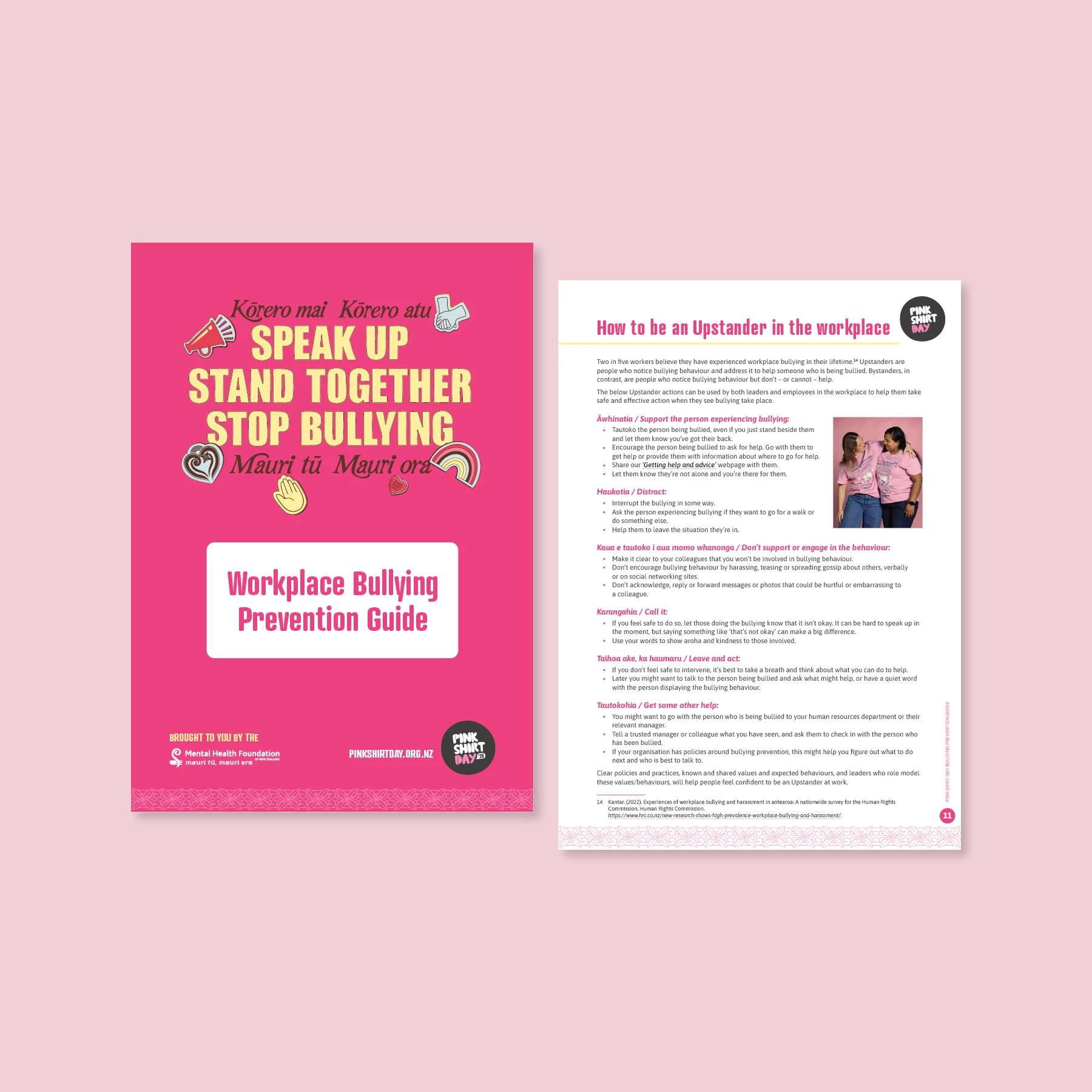
Workplace guide
A resource designed to help workplaces build positive environments and prevent bullying.
Download Resource
To download this free resource, please enter your details below. We’ll also add you to our Pink Shirt Day newsletter to help you make the most of the kaupapa and learn about our bullying prevention initiatives (you can unsubscribe at any time).
After you submit your details, you will be redirected back to this page, where you can download the files for this free resource.
Download Resource
Click on one of the file options below to download this free resource.
More Resources

Ethnicity, workplace bullying, social support and psychological strain in Aotearoa/New Zealand
Gardner, D., Bentley, T. A., Catley, B. E., Cooper-Thomas, H., et al. (2013). New Zealand Journal of Psychology, 42(2), 84-91. 1,733 respondents from four sectors (health, education, hospitality and travel) responded to a self-report questionnaire. Despite reporting higher levels of bullying than New Zealand Europeans, Pacific Island and Asian/Indian respondents reported lower levels of psychological strain. Respondents with more supportive supervisors and colleagues reported experiencing less bullying and less strain. Bullying was related to negative outcomes for all groups.

Kidpower, teenpower, fullpower
A charitable trust that provides effective, positive and fun training in violence prevention, personal safety and self-defence for real life situations, suitable for all ages and all abilities.
Bystanders’ experiences of witnessing workplace bullying incidents in the New Zealand hospitality industry: What factors affect their attitudes and behaviours?
Wu, L. (2020). Thesis, Auckland University of Technology. The definition, causes, effects and influential factors on workplace bullying have been investigated by many scholars. However, research objectives until now, have mainly focused on victims and perpetrators, with little attention given to the bystanders, the individuals who witness the bullying. This small-scale qualitative interpretivist study aimed to investigate factors that affect bystanders’ attitudes and behaviours by conducting eight semi-structured interviews to explore the experiences of witnessing workplace bullying incidents in Auckland hospitality organisations in New Zealand. The findings suggest that the bystander effect does occur in the New Zealand hospitality industry; as bystanders, participants’ attitudes and behaviours were affected in a variety of ways: the industry working conditions, their witnessing experiences, their personality and home-country culture, their organisation’s culture, and their managerial position and visa status.
Kōrero Mai, Kōrero Atu, Mauri Tū, Mauri Ora
Speak Up, Stand Together, Stop Bullying!
